19 Nov 26

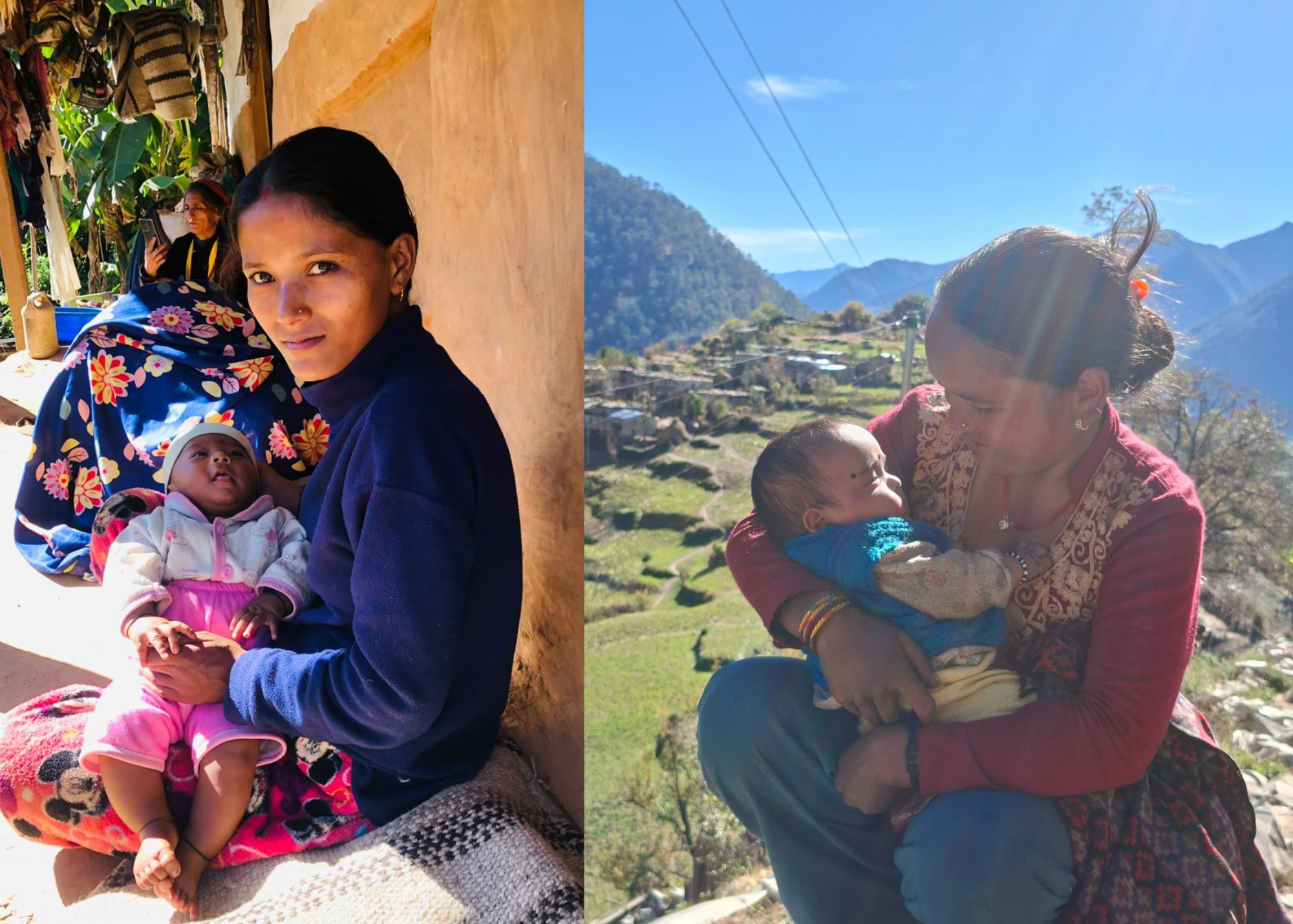
Yuna, a remote village in Himali Rural Municipality, Bajura, lies four hours’ walking distance from the PHASE-supported Bichhya Health Post. Bichhya itself is approximately eight hours’ walking distance from the nearest road access.
Although Yuna has a Basic Health Service Centre with an Auxiliary Health Worker (AHW) and an Auxiliary Nurse Midwife (ANM) deployed by the Rural Municipality, only the AHW was available at the time of the event.
On 4 August 2026, two young women from the same village experienced the same potentially life-threatening childbirth complication, highlighting both the challenges of accessing maternal healthcare in remote communities and the importance of dedicated frontline health workers.
Two young mothers preparing for childbirth
Kalida, 22, lives with her husband and extended family in a household of nine members. Agriculture is the family’s main source of livelihood. Expecting her first child, Kalida had initially planned to travel to Surkhet for childbirth but was unable to do so due to financial constraints.
Sita , 20, lives with her husband and extended family in a household of six members, also dependent on agriculture for their livelihood.
Both women live just a five-minute walk from Yuna Basic Health Service Centre. However, access to skilled maternity care remains a challenge, particularly during emergencies when additional medical support is several hours away on foot.
Both women had received secondary-level education and actively participated in antenatal care sessions, mothers’ group meetings and other community health activities organised by PHASE. They had completed all eight recommended antenatal care visits at the local Basic Health Service Centre and received ultrasound services at the PHASE-supported Bichhya Health Post.
Despite their preparations, unexpected circumstances placed both mothers at risk during childbirth.
Two emergencies: one rainy night
At around 1 am, Kalida began experiencing vaginal discharge and backache. It was the monsoon season, and the difficulties of travelling at night in the rain, together with the absence of an ANM at the local health facility, meant that she remained at home.
At around 9 am, she delivered a baby boy weighing 3.4 kg. However, her placenta did not come out following the delivery. Her family tried traditional remedies, but these did not help. As her abdominal pain gradually increased, Kalida became increasingly worried and began to lose hope.
On the same night, just a short distance away, Sita also experienced signs of labour. Due to the rain, darkness and absence of an ANM at the local health facility, she too remained at home.
At around 5 am, Sita delivered a baby boy weighing 3.5 kg. Like Kalida, she experienced a retained placenta. After waiting for two hours, her family tried traditional remedies and local techniques, but the placenta remained undelivered.
Both women were experiencing retained placenta, a serious obstetric complication that can lead to severe postpartum bleeding, infection and even maternal death if not managed promptly.
A four-hour journey to provide emergency care
At around 10:30 am, the AHW at Yuna Basic Health Service Centre contacted PHASE’s ANMs at Bichhya Health Post. He had already informed the Rural Municipality’s Health Section about the situation.
“Sister, there have been two deliveries in our community today. Neither woman’s placenta has been delivered. Their vital signs are normal, and the babies are doing well, but the women are worried,” he reported.
Following consultation, two PHASE ANMs and one government ANM from Bichhya Health Post set off for Yuna, carrying delivery kits, essential medicines and medical supplies.
Despite the monsoon conditions and difficult mountain terrain, the three health workers walked for four hours to reach Yuna Basic Health Service Centre, where both mothers were awaiting treatment.
Emergency intervention and safe recovery
Upon arrival, the ANMs assessed both mothers and their newborns. Although the mothers’ vital signs were stable, both had retained placentas and distended urinary bladders.
The ANMs performed urinary catheterisation to empty their bladders and provided emergency obstetric care. Both placentas were successfully delivered.
Both mothers were also found to have third-degree perineal tears, which were repaired by the health workers. The ANMs administered necessary medicines, including oxytocin, and provided essential newborn care, including vitamin K injections and umbilical cord care. They also supported the mothers with breastfeeding and recovery.
Both mothers and their newborns were kept under observation for 24 hours. The babies were breastfeeding normally, and both mothers and their newborns were subsequently discharged in stable condition.
“I feel as though I have been given a second life”
Relieved and grateful after receiving treatment, Kalida shared:
“You came from such a distant health post, even on a rainy day, and saved our lives. If you had not come, I might have died. I feel as though I have been given a second life.”
Sita also expressed her gratitude to the health workers and PHASE:
“Sister, you saved me. I am alive today. I don’t know what would have happened if you had not been here. Thank you and PHASE so much.”
The family members of both mothers also expressed their heartfelt gratitude to PHASE and the health workers for responding promptly and walking four hours to provide the care they urgently needed.
For both families, returning home safely with their newborns brought immense relief and happiness.
Care beyond the emergency
PHASE’s support did not end with the emergency response. PHASE ANMs subsequently visited both mothers at their homes to provide postnatal care, monitor their recovery and assess the health of their newborns.
Both babies have since received their BCG vaccination and the first two doses of DPT-containing vaccines. The mothers have also received counselling on family planning methods.
For Kalida and Sita, PHASE’s presence has meant access to essential maternal healthcare throughout their pregnancies, emergency support when complications arose during childbirth, and continued care following the birth of their babies.
In a community where access to additional healthcare services requires several hours of walking, this continuity of care is particularly important for mothers, newborns and their families.
Bringing essential healthcare closer to remote communities
To support health workers get to more mothers like Kalida and Sita give to the Big Give and your donation will be doubled
Give to the Big Give Christmas Campaign from 1st December 2026
https://bit.ly/PHASEBGXMAS26
2026
Project objectives Empower 100 mothers with kitchen garden knowledge and support with vegetable seeds and materials to grow more to feed their families more nutritious…
2025 - ongoing
This project initiated by a group of our GP mentors is a small pilot running across Rugin, Bichhya and Jair in the far west of…
The centre of Bichhya is an arduous 8 hours walk away from the next closest village of Rugin (another PHASE Project area) along rugged mountain paths (or 5 hours to a remote jeep track) It is only accessible on foot. All medicines and equipment are brought in by mules and porters.
Across all of the districts PHASE works in, Bajura evidences the highest rates of food poverty.
If you would like to support the work of PHASE Worldwide and help us to continue empowering people living in isolated regions of Nepal the best way to do so is through regular giving. Even the smallest amount a month can make a huge difference. As a regular supporter you will receive exclusive updates and will become part of the PHASE family. You can set up your regular gift easily and securely online.