6 Jul 26
Tumcha and Jair – 12 months in review
Thank you for taking the time to read this article. The best way to support this type of work at Tumcha and Jair is to donate regularly to PHASE Worldwide. Donate today

Ensuring food security is a key part of our integrated health, education and livelihoods projects. The term ‘food security’ is widely understood as the ability of all people at all times to have access to sufficient and nutritious food. The achievement of food security is a universal aim, with recent events highlighting the fragility of such security, even within the developed world, and the need for increased local, sustainable food production. Working towards UN Sustainable Development Goal 2: Zero Hunger, we would like to share the impact of our work towards eliminating malnutrition and improving food security in Nepal.

Accessing food can be a daily struggle for those living in remote communities, exacerbated by the effects of climate change, poor quality land and a lack of agricultural training. Whilst small-scale agriculture supports over 80% of the populations of rural Nepal, in some areas of the Far West, 90% of families are only able to grow enough food for 3-6 months of the year. PHASE attempts to address this disparity through dedicated sustainable livelihoods projects, which address food security and malnutrition. Our projects promote self-sufficiency and resilient farming techniques; such as training in fruit and vegetable cultivation, the use of polytunnels to mitigate the effects of climate change, fodder management and composting, goat breeding, and sapling and seed selection. This agricultural training is compounded by the creation of cooperatives and farmers groups which allow opportunities for knowledge sharing, leadership and decision making at the local level. These groups also foster the creation of small-scale enterprises, boosting overall household income.
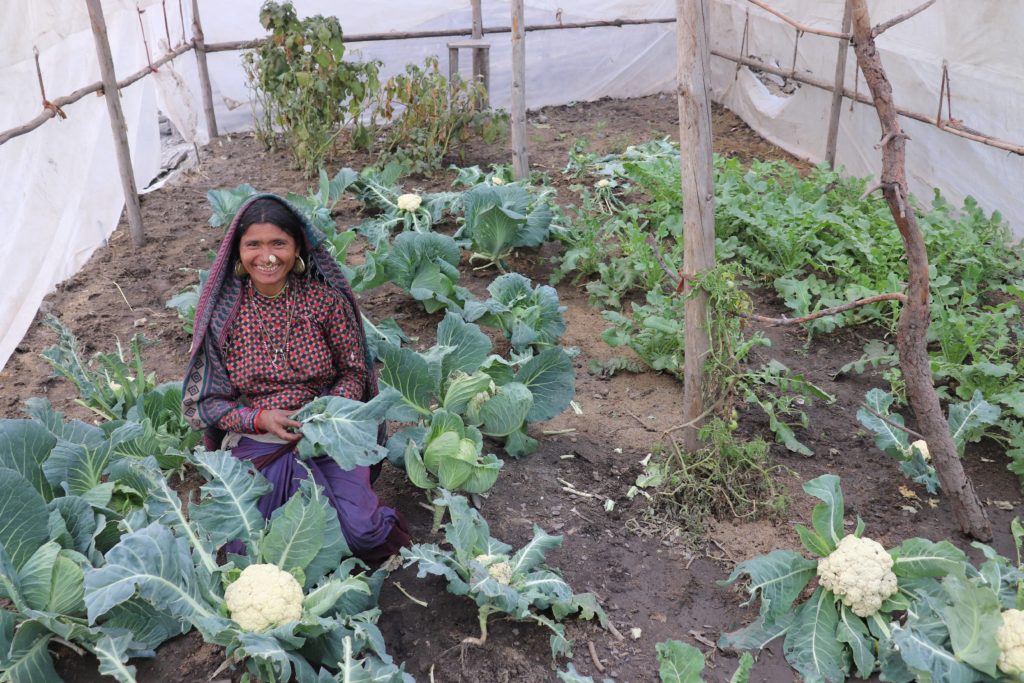
Our DFID UK Direct Aid funded project, Addressing Causes of Malnutrition in Mugu, saw the use of mushroom cultivation as a key to addressing malnutrition and food insecurity. Whilst holding exceptional nutritional value, the training provided to female farmers by PHASE on mushroom cultivation has empowered them to have independence in providing for their families. Furthermore, excess mushrooms have strong income generation protentional. This project is a prime example of PHASE’s integrated, sustainable approach to development, incorporating long term solutions to food insecurity with female empowerment.
On Sunday the 5th of April, we will be launching our BBC Radio 4 appeal which will be raising money to support our work around food security. Click here to find out how you can listen to our BBC Radio 4 appeal.
If you would like to support the work of PHASE Worldwide and help us to continue empowering people living in isolated regions of Nepal the best way to do so is through regular giving. Even the smallest amount a month can make a huge difference. As a regular supporter you will receive exclusive updates and will become part of the PHASE family. You can set up your regular gift easily and securely online.
Thank you for taking the time to read this article. The best way to support this type of work at Tumcha and Jair is to donate regularly to PHASE Worldwide. Donate today
We raised over £22,000 for communities in Nepal. Huge thanks to everyone that gave. Next Big Give with match funding December 2026. To have your donations doubled visit our Big Give page All money raised will save and change lives in the beautiful, remote and isolated Far West of Nepal….
Many supporter might not know that as well as running integrated health, education and livelihood programmes in Nepal, PHASE Nepal also have a research team working and publishing academic research. PHASE Nepal have been engaged in research activities across various areas, including but not limited to public health, community health,…